
Neck Shoulder Ache: Understanding Everyday Tension and Building Kinder Daily Habits
*General information disclaimer: This article is for general information only and is not medical advice. It does not diagnose any condition or recommend any treatment. If you have persistent, new, severe or worrying pain, pain after an injury, numbness, weakness, or symptoms that concern you, speak to a qualified health professional promptly rather than relying on general information online.*
A neck shoulder ache is one of the most familiar everyday complaints in modern life. It is the tightness that creeps in during a long afternoon at a desk, the stiffness that greets you after a night of poor sleep, or the dull heaviness across the tops of the shoulders after hours spent looking down at a phone. It rarely arrives with a dramatic story. More often it builds quietly, out of ordinary habits repeated day after day, until one morning you notice that turning your head feels restricted or that your shoulders seem to live permanently somewhere near your ears. Understanding what contributes to that feeling, in general terms, is the first step towards building a daily routine that is kinder to your neck and shoulders.
It helps to start with a simple picture of the area involved. The neck and shoulders form a busy junction where the head, the spine, the ribcage and the arms all meet. The muscles here do a great deal of quiet work: holding the head upright, supporting the arms, and stabilising the upper back during almost everything you do, from reading and typing to carrying shopping and driving. When that workload is uneven, when one position is held for a very long time, or when rest and movement are in short supply, the area can feel tired, tight and achy. That general pattern explains why neck and shoulder discomfort is so often linked to the shape of an ordinary day rather than to a single dramatic event.
What Everyday Life Does to the Neck and Shoulders
Desk work is the most commonly discussed contributor, and the reason is straightforward. Sitting for hours with the head pushed forward towards a screen, the shoulders rounded and the arms reaching for a keyboard places a sustained demand on the muscles of the neck and upper back. None of those positions is harmful in itself for a few minutes, but held for hours without change, they ask the same small group of muscles to work without a break. The result, for many people, is a familiar end-of-day tightness across the shoulders and the base of the neck, sometimes accompanied by a feeling of heaviness or a mild headache. The problem is less about one bad posture and more about staying in any one posture for too long.
Phone use adds a similar pattern in a different shape. Looking down at a handheld screen for long periods tilts the head forward and increases the work asked of the neck muscles, while the shoulders often creep upwards at the same time. Add commuting, carrying bags on one shoulder, and evenings spent on a sofa with the neck propped at an awkward angle, and the picture becomes clear: the neck and shoulders rarely get a genuinely varied day. They get a series of similar, sustained positions, punctuated by too little movement in between.
Sleep and rest play a part as well, in general terms. A night spent in an awkward position, or a pillow that leaves the neck poorly supported, can leave a person waking with stiffness that takes time to ease. Equally, a run of short or broken nights can leave the whole body feeling more sensitive to everyday strain, so that a normal working day feels harder on the neck and shoulders than it otherwise would. Rest is not a luxury for this area of the body; it is part of how the muscles recover from the demands of the day, and our guide to the art of napping explores how short, well-timed daytime rest can fit alongside healthy night sleep as part of a broader recovery routine.

Stress, Tension and the Shoulders
Emotional strain and physical tension are closely connected, and the shoulders are one of the places where that connection shows up most clearly. When people feel rushed, worried or under pressure, they often tighten their shoulders without noticing, clench their jaw, or breathe more shallowly from the upper chest. Over a stressful week, that low-level tightening can become a habit, so that the shoulders stay raised even after the stressful moment has passed. This is a normal human response, not a personal failing, but it does mean that a purely physical approach to neck and shoulder discomfort can miss an important part of the picture.
That is why general wellbeing habits often sit alongside movement habits in discussions of everyday tension. Practices that help a person notice tension and let it soften, such as slow breathing or a few minutes of calm attention during the day, can be a useful part of a daily routine for many people. Our guide to meditation techniques for anxiety introduces such practices in plain terms, including breathing-focused practice and body awareness, and it explains how to build a small daily habit without pressure. For younger people in particular, tension and low mood can travel together, and our guide to youth emotional support explains how listening, routine and supportive relationships help young people feel heard and steady, which is a reminder that wellbeing is rarely about one single habit.
It is important to keep this in perspective. General information about stress and tension is not a diagnosis, and it does not explain every ache. Some neck and shoulder symptoms have causes that need professional assessment, and no amount of general advice about posture or relaxation replaces that assessment. The value of understanding the stress connection is simply that it encourages a broader view: a day that includes movement, breaks, rest and calmer moments is generally kinder to the neck and shoulders than a day that is rushed, static and tense from start to finish.
Building a Kinder Desk and Daily Setup
Small changes to a desk setup can make a long working day feel noticeably easier, and they do not require expensive equipment. The most useful general principles are to bring the screen to a comfortable eye level so the head does not tilt sharply down, to keep the keyboard and mouse close enough that the shoulders do not have to reach forward, and to choose a chair that supports the lower back while allowing the feet to rest flat. If a screen is too low, a simple stand or a stack of books can raise it; if a chair is too low or too high, adjusting it, or adding a footrest, can change the whole posture of the upper body. The goal is not a perfect, rigid position but a setup that makes a relaxed, upright posture the easy option rather than a constant effort.
Lighting and screen habits matter too. A screen that is too bright, too dim or badly positioned can lead to squinting and leaning forward, which quietly adds to neck strain. Placing the screen so that it does not catch glare from a window, keeping text at a readable size, and taking regular breaks from close screen work all help the eyes and the neck together. The well-known habit of looking away from the screen regularly, and blinking fully, is a small act that supports both comfort and concentration, and it pairs naturally with the movement breaks described below.
Outside work, everyday carrying habits deserve a quick review. A heavy bag carried on one shoulder day after day loads one side of the body more than the other, while a bag worn across the body or a backpack with both straps used tends to spread the load more evenly. Similarly, holding a phone between the ear and the shoulder during long calls, or cradling a child on one hip for hours, asks the neck and shoulder muscles to hold an uneven position for a long time. None of these habits needs to be eliminated entirely, but varying them, switching sides, and putting a bag down when possible all reduce the sustained demand on any one set of muscles.
Movement Breaks and General Flexibility
If there is one habit that general advice about neck and shoulder comfort returns to again and again, it is regular movement. The neck and shoulders are designed to move through a range of positions, and a day that includes frequent small changes of position tends to feel better than a day spent locked in one place. That does not mean an intense workout is required. It means standing up regularly, walking around the room, rolling the shoulders gently, turning the head slowly from side to side, and letting the arms hang and swing naturally. Short, frequent breaks are generally more useful than a single long session at the end of a day of stillness, because they interrupt the sustained positions that cause trouble in the first place.
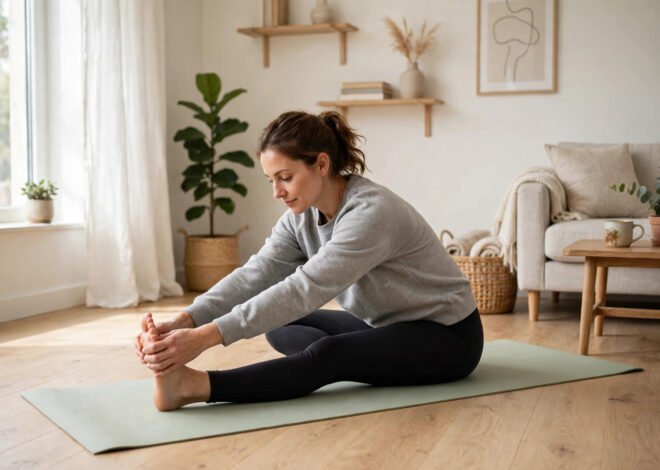
General flexibility work supports the same idea. Gentle, regular stretching of the whole body helps the shoulders move more freely and helps the upper back stay mobile, which in turn takes some of the burden off the neck. Our guide to the best exercises for flexibility at home offers a beginner-friendly routine that covers the hamstrings, hips, back, chest and shoulders, with clear safety principles such as warming up first, moving slowly, and stopping at a gentle pull rather than pushing into pain. Those same principles apply to any general movement: move slowly, breathe normally, keep the range comfortable, and stop if anything feels sharp or increasingly painful.
It is worth being honest about what movement breaks can and cannot do. They are a general wellbeing habit, not a treatment, and they will not resolve every cause of neck or shoulder pain. Some people find that a particular movement aggravates their symptoms, and that is useful information to take to a professional rather than something to push through. The aim of general movement is modest and realistic: to break up stillness, to keep the area mobile, and to make the working day feel less like a single long strain on the same muscles.

Sleep, Rest and the Night-Time Picture
Sleep is the longest single position most people hold each day, so it is worth giving it a little thought. A pillow that is too high or too flat can leave the neck bent or unsupported through the night, and a mattress that has lost its support can make comfortable sleep harder to find. There is no single pillow or mattress that suits everyone, because body shape, preferred sleeping position and personal comfort all differ, but the general principle is consistent: the head and neck should be supported in a roughly neutral alignment with the spine, rather than propped sharply upwards or allowed to drop. Trying a different pillow height, or adjusting how many pillows are used, is a simple experiment that many people find informative.
Sleeping position itself is a matter of comfort and habit. Side sleepers often need a pillow that fills the gap between the head and the shoulder, while back sleepers usually need less height, and front sleepers, who tend to turn the head sharply to one side, often find that position the least comfortable for the neck. None of this is a rule, and changing a lifelong sleeping position overnight is neither easy nor necessary. Small adjustments, such as a pillow that better fills the shoulder gap or a supportive cushion under the knees, can make a night feel more restful without a complete overhaul of sleep habits.
Beyond the pillow, the broader sleep routine matters. Regular bedtimes, a wind-down period before bed, a dark and cool bedroom, and limits on late-night screen use all support the kind of sleep that leaves the body feeling restored rather than stiff and tired. When sleep is regularly poor, daytime tension often feels worse, and daytime tension can in turn make sleep harder, so the two feed into each other. Breaking that loop, even gently, by protecting one part of the routine, such as a consistent wake time or a calmer evening, can be a useful place to start.

When to Seek Professional Advice
General information has limits, and knowing those limits is part of using it well. It is sensible to seek professional advice promptly if neck or shoulder pain is severe, if it follows an injury or accident, if it is accompanied by numbness, weakness, tingling in the arms or hands, changes in bladder or bowel function, fever, unexplained weight loss, or pain that is new and unexplained. The same applies if pain persists for more than a short period, keeps returning, is getting worse rather than easing, or interferes significantly with sleep, work or daily activities. A professional can assess the individual situation, which general articles cannot do, and can advise on next steps that fit the person rather than the average reader.
It is also worth seeking advice if you are unsure. Many people hesitate because their symptoms feel ordinary, or because they worry about wasting a professional’s time, but a new or persistent symptom is a legitimate reason to ask. A single conversation can often clarify whether a symptom fits an everyday pattern or whether further assessment is needed, and that clarity is valuable in itself. Keeping a simple note of when symptoms appear, what you were doing, and how long they last can help that conversation, because patterns that are hard to remember in detail are much easier to describe from a short written record.
A Gentle Daily Routine to Take Away
Pulling the general ideas together, a kinder day for the neck and shoulders looks less like a strict programme and more like a set of small, repeatable habits. Set up the desk so that a relaxed posture is easy, and adjust the screen and chair rather than forcing the body to fit a poor setup. Break up long periods of sitting with short movement breaks, and include some gentle, whole-body flexibility work a few times a week. Carry loads evenly where possible, and vary the side you use. Protect sleep with a supportive pillow and a calm wind-down, and notice when stress is tightening the shoulders, using a few slow breaths or a short calm pause to let that tension soften. None of these habits needs to be perfect to be useful, and a day that includes most of them will generally feel kinder than a day that includes none.
Frequently Asked Questions
Is neck shoulder ache usually caused by poor posture?
In general terms, sustained positions, such as sitting at a desk or looking down at a phone for long periods, are commonly associated with everyday neck and shoulder tightness. The pattern is usually about duration rather than a single position: any posture held without change for hours can leave the area feeling tired. Persistent, severe or worrying symptoms should be assessed by a professional, as general information cannot identify individual causes.
Does a new pillow help with neck stiffness?
A pillow that supports the head and neck in a roughly neutral alignment with the spine can make sleep more comfortable for many people, and adjusting pillow height is a simple experiment to try. There is no single pillow that suits everyone, and pillow changes are a general comfort measure, not a treatment for any condition.
How often should I take movement breaks at a desk?
As a general habit, short, frequent breaks are more useful than rare, long ones. Standing, walking around the room, and gently moving the neck and shoulders at regular intervals through the working day helps break up the sustained positions that contribute to everyday tightness.
When should I worry about neck or shoulder pain?
Seek professional advice promptly for severe pain, pain after an injury, numbness or weakness, tingling in the arms or hands, or symptoms that persist, worsen or interfere with daily life. When in doubt, asking a qualified health professional is the safest step.
Conclusion
A neck shoulder ache is, for many people, a signal from an ordinary day rather than a mystery: too much sitting, too little movement, a desk that asks the body to strain, a night of poor rest, or a stressful week held in the shoulders. The general habits that help are correspondingly ordinary, and that is encouraging. A better desk setup, regular movement breaks, gentle flexibility work, attention to sleep, and moments of calm during the day will not solve every problem, but they make the everyday load on the neck and shoulders lighter and more varied. Use them as general information, notice what helps, and seek professional advice whenever symptoms are persistent, severe or worrying, because your own situation deserves an assessment that no general article can provide.