

Kettlebell Windmill Guide: Form, Benefits, Muscles Engaged, Variations, and More
Many physical activities require coordination, balance, and mental focus. Whether it is balancing an object while walking or performing a complex athletic movement, the body must coordinate multiple abilities at once. The Kettlebell Windmill is an exercise that develops these abilities together.
This movement trains both the body and the mind. It requires planning the movement, coordinating the body position, and maintaining balance while holding a weight overhead. Because of this combination, the kettlebell windmill is often included in functional fitness programs. Unlike traditional exercises that focus on a single muscle group, the kettlebell windmill trains strength, mobility, balance, and stability simultaneously. For this reason, many coaches consider it one of the most useful kettlebell exercises for improving overall body control.
What Is the Kettlebell Windmill
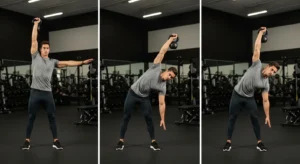
The Kettlebell Windmill is a kettlebell exercise that involves holding a kettlebell overhead while bending the torso sideways toward the opposite leg. During the movement, most of the motion comes from the hips while the upper body stays aligned under the kettlebell. The goal of the exercise is to maintain stability while the body moves through a controlled range of motion. The arm holding the kettlebell remains extended overhead while the other hand moves down toward the leg or ankle. This movement improves both stability and mobility. It trains the body to control movement rather than lift a weight. That is why many strength coaches use the exercise in functional training routines.
Another reason the kettlebell windmill is popular is that it helps teach the hip hinge movement. Learning proper hip hinge mechanics can improve performance in exercises such as deadlifts, squats, and kettlebell swings. Because of these benefits, the kettlebell windmill exercise is often classified as both a mobility exercise and a strength exercise.
Benefits of the Kettlebell Windmill
This exercise provides several important physical benefits and supports overall athletic performance.
Core Stability Improvement
The core muscles play a major role during this movement. They stabilize the torso while the body bends sideways. Practicing the exercise regularly strengthens the abdominal muscles and improves stability during other strength exercises.
Shoulder Stability Development
Holding a kettlebell above the head requires strong shoulder control. This helps develop the shoulder muscles and improves stability during overhead movements.
Improved Hip Mobility
The combination of hip hinge and side bending stretches the hips and hamstrings. This movement helps increase flexibility and reduce stiffness in the lower body.
Better Balance and Coordination
The movement requires careful control and body awareness. Over time, it improves balance, coordination, and overall movement control.
Functional Strength Development
Unlike isolation exercises, the windmill engages many muscles at once. This helps develop strength that transfers to everyday activities and sports performance.
Muscles Worked in the Kettlebell Windmill
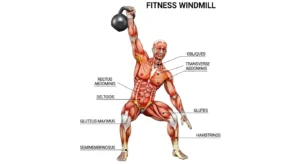
The windmill exercise is considered afull-bodyy movement because it activates multiple muscle groups simultaneously.
Primary Muscles
Obliques
These muscles are responsible for stabilizing the torso during the sideways bending movement.
Deltoids
The shoulders support the kettlebell in the overhead position throughout the exercise.
Glutes
The glute muscles control the hip hinge and help return the body to a standing position.
Hamstrings
These muscles help maintain leg stability and assist with the movement.
Secondary Muscles
Several additional muscles assist during the exercise.
Rotator cuff muscles help stabilize the shoulder joint.
The lat muscles support upper body stability.
The triceps help keep the arm extended overhead.
Lower back muscles help maintain spinal support during the movement.
Because many stabilizing muscles are involved, the exercise improves both strength and body control.
How to Perform the Kettlebell Windmill Step by Step
Before adding heavy weight to the exercise, it is important to master proper technique.
Step 1: Start in a Stable Position
Stand with your feet slightly wider than shoulder width apart. Turn the toes of the leg opposite the kettlebell slightly outward.
Step 2: Press the Kettlebell Overhead
Lift the kettlebell overhead with one arm and keep the arm straight.
Step 3: Begin the Hip Hinge
Push your hips backward while keeping your chest open.
Step 4: Slide the Free Hand Down the Leg
Lower your torso slowly while sliding your free hand down your leg toward the ankle.
Step 5: Keep Your Eyes on the Weight
Maintaining eye contact with the kettlebell helps keep the shoulder aligned and improves balance.
Step 6: Return to the Starting Position
Drive through the hips and return to standing while keeping the kettlebell overhead.
Practicing slowly helps build control and proper technique.
Common Mistakes in the Kettlebell Windmill
Many beginners make mistakes when learning this exercise. Avoiding these errors will improve both safety and effectiveness.
Leaning Forward Instead of Sideways
The movement should come from the hips while the torso bends sideways. Leaning forward can put stress on the lower back.
Using Too Much Weight
Starting with heavy kettlebells can make the exercise difficult to control. Lighter weights allow better technique development.
Losing Shoulder Alignment
If the kettlebell moves forward or backward, shoulder stability may be compromised. Keep the arm aligned above the shoulder.
Incorrect Foot Placement
Proper foot positioning helps maintain balance and allows the hips to move correctly.
Focus on proper technique rather than performing many repetitions.
Kettlebell Windmill Variations
Once the basic movement becomes comfortable, several variations can be used to increase the challenge.
Low Windmill
In this variation, the kettlebell stays near the ground while the body performs the movement.
High Windmill
The kettlebell remains overhead throughout the entire movement, increasing shoulder stability demands.
Bent Arm Windmill
The kettlebell stays closer to the shoulder instead of being fully extended.
Double Kettlebell Windmill
Advanced trainees may perform the exercise with two kettlebells for an added challenge.
These variations allow the exercise to remain effective as strength and skill improve.
Best Kettlebell Weight for Beginners
Choosing the correct kettlebell weight is important when learning the movement. Beginners should start with lighter kettlebells so they can focus on technique and body control. A common starting range is between 8 and 12 kilograms,s depending on the individual’s strength level. Once balance and control improve, heavier weights can gradually be introduced. Increasing the load slowly helps maintain proper form and reduce injury risk.
Mobility Exercises to Prepare for Windmills
Limited flexibility can make the windmill exercise difficult. Performing mobility drills before training can help prepare the body.
Thoracic Spine Rotations
These movements improve upper back mobility and help maintain proper posture.
Hip Mobility Drills
Hip stretches and hinge drills prepare the body for the side-bending movement.
Shoulder Activation Exercises
Light shoulder exercises help prepare the joints for supporting a kettlebell overhead.
Including these drills in a warm-up routine can improve movement quality and reduce injury risk.
Programming the Kettlebell Windmill in Workouts
The exercise can be used in different types of training routines. Some athletes include it during their warm-up because it activates the core and shoulders. Others use it as an accessory exercise during strength training. A common approach is performing three sets of five to eight repetitions on each side. Because the movement requires focus and control, it is often performed early in a workout session. Regular practice can gradually improve both strength and mobility.
Kettlebell Windmill vs Turkish Get Up
The windmill is often compared with the Turkish Get Up because both exercises involve holding a kettlebell overhead. The windmill focuses mainly on hip hinge movement and lateral bending. The Turkish get-up involves moving from the floor to a standing position while maintaining the kettlebell overhead. Both exercises improve coordination, shoulder stability, and core strength. Including both movements in a workout routine can provide balanced functional training.
Safety Tips and Injury Prevention
Safety should always be a priority during strength training.
Engage your core during the movement to support the spine.
Move slowly and maintain control throughout the exercise.
Keep the kettlebell aligned above the shoulder to maintain stability.
Start with lighter weights and increase gradually as technique improves.
Following these guidelines helps reduce injury risk while improving training effectiveness.
Frequently Asked Questions
Is the kettlebell windmill suitable for beginners
Yes. Beginners can practice this exercise if they start with light weights and focus on learning correct technique.
What muscles are used in this exercise
The exercise mainly targets the core, shoulders, glutes, and hamstrings, while several stabilizing muscles assist.
How often should the exercise be performed?d
Many people include the movement in their workout routines two or three times per week.
Conclusion
The Kettlebell Windmill is a powerful functional exercise that develops strength, stability, and mobility. By combining a hip hinge movement with an overhead load, it trains multiple muscle groups at the same time.
With consistent practice and proper technique, this exercise can improve shoulder stability, strengthen the core, and enhance overall coordination. Whether you are new to kettlebell training or looking to expand your exercise routine, adding the windmill can provide long-term benefits for strength and movement quality.
